Fortis Novum Mundum
The Four-Floor War
A Manual for Military Operations on Urban Terrain
"Modern military doctrine is not aligned with the environment in which war is actually fought."
Josh Luberisse
The Urban Battlespace Is Not What Doctrine Assumes
The city is not a flat terrain with buildings on it. It is a layered, three-dimensional environment that extends vertically from subterranean infrastructure to rooftops, and conceptually from the physical domain through the informational and cognitive dimensions of conflict. Forces operating in cities confront a battlespace that is simultaneously surface-level, vertical, subterranean, informational, and cognitive—each layer imposing distinct constraints and requiring distinct capabilities.
Yet existing military doctrine continues to treat urban operations as a variant of conventional maneuver—applying frameworks designed for open terrain to an environment that fundamentally resists them. The result is a persistent and widening gap between how doctrine conceptualizes urban warfare and how it actually unfolds.
The operational consequences of this gap are not theoretical. They manifest in every urban engagement where forces discover, too late, that the environment itself has become the adversary's most effective weapon system.
The Problem
The Doctrinal Gap
Current military frameworks for urban operations remain anchored to assumptions developed during an era of open-terrain maneuver warfare. They acknowledge the city as a challenging environment but fail to reconceptualize it as a fundamentally different type of battlespace requiring fundamentally different operational logic.
The consequence is doctrinal fragmentation. Urban combat is treated as a collection of tactical problems—room clearing, breaching, close-quarters engagement—rather than as an integrated operational challenge spanning multiple physical and non-physical domains simultaneously.
This fragmentation is not merely academic. It produces planning failures, capability mismatches, and an inability to synchronize effects across the vertical, subterranean, surface, and information dimensions of the urban fight. The doctrinal gap is not a gap in knowledge. It is a gap in conceptual architecture.
The Framework
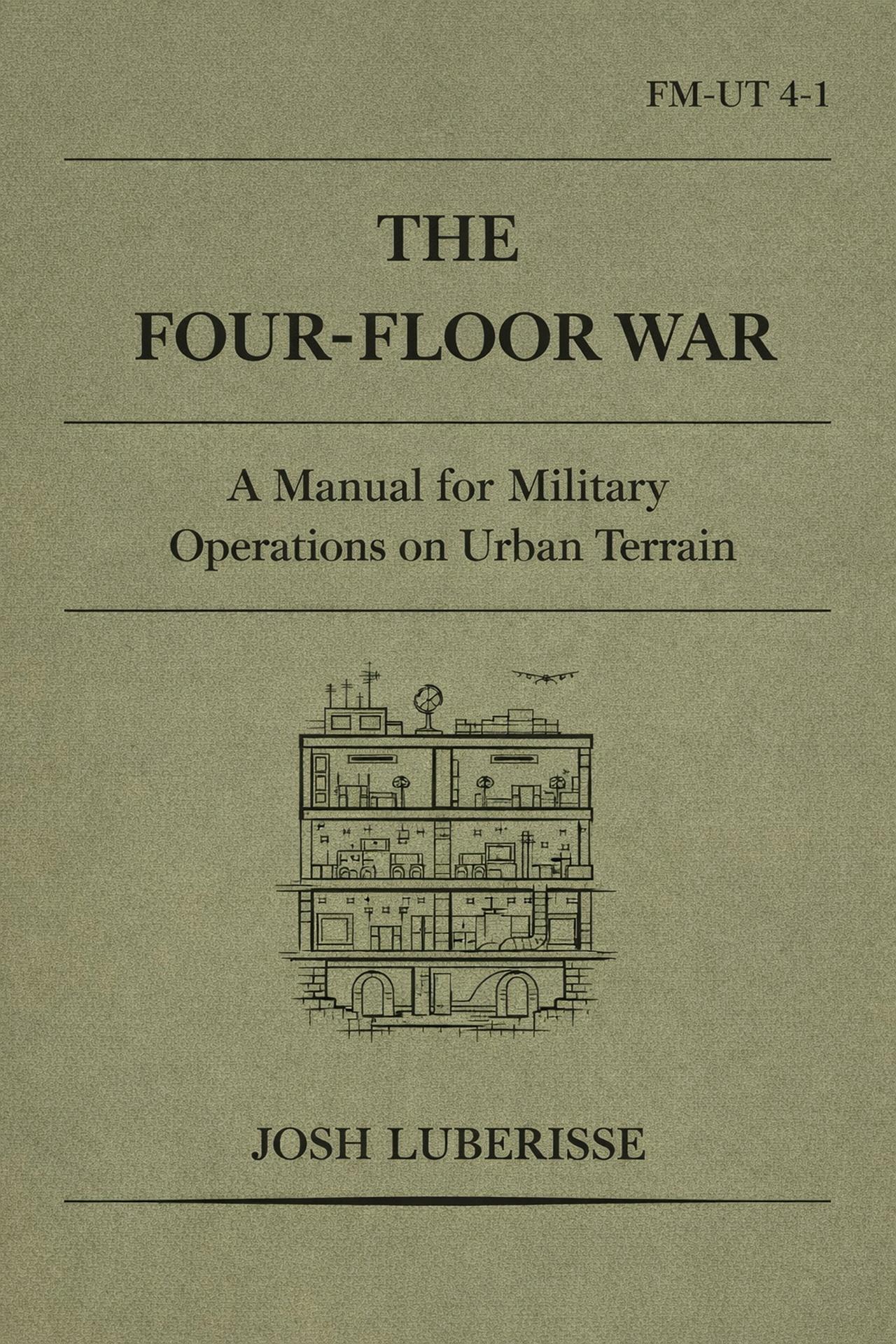
The Four-Floor War
The Four-Floor War model reconceptualizes urban terrain as a layered operational environment. Each "floor" represents a distinct domain that must be understood, contested, and integrated into a coherent operational approach.
Cognitive & Information Domain
Narrative control, perception management, population dynamics
Vertical & Aerial Domain
Rooftops, upper floors, UAS corridors, observation
Surface Domain
Street-level maneuver, structures, intersections, barriers
Subterranean Domain
Tunnels, sewers, basements, underground infrastructure
The model demands integration—not merely acknowledgment—across all four floors. Operations that succeed on the surface but fail in the subterranean or cognitive domain do not succeed. They simply defer failure.
Inside the Book
What This Book Delivers
Physical Dimension of Urban Combat
A rigorous analysis of the structural, geometric, and material constraints that define close combat in built-up areas—from room geometry to building typology to block-level tactical patterns.
Subterranean & Vertical Battlespace
An examination of the domain above and below the surface: tunnel networks, basement complexes, rooftop positions, and the vertical integration challenge that most doctrine ignores entirely.
Information & Cognitive Warfare
The informational and psychological dimensions of urban operations—narrative control, population perception, adversary information campaigns, and the cognitive load imposed on decision-makers.
Sustainment & Logistics Constraints
How the urban environment transforms logistics from a support function into an operational constraint—constricted supply lines, infrastructure dependency, and the mechanics of sustaining forces in dense terrain.
Multi-Domain Integration
The central challenge: synchronizing effects across physical, subterranean, vertical, informational, and cognitive domains within the compressed timelines and reduced visibility of urban combat.
Positioning
A Doctrinal Contribution
This book is not a tactical manual. It does not prescribe techniques for room clearing or building entry. It is not a historical survey of urban battles, nor a compilation of lessons learned from specific operations.
It is a conceptual framework—a structured argument for how military organizations should think about, plan for, and execute operations in the urban environment. It addresses the level of analysis between strategy and tactics: the operational and doctrinal architecture that shapes how forces are organized, equipped, trained, and employed in cities.
The intent is to contribute to the professional body of knowledge in a domain where clarity of thought remains dangerously insufficient.
Readership
Who This Is For
Military Professionals
Officers and NCOs engaged in operational planning, force design, and doctrinal development for urban and complex terrain environments.
Defense & Policy Analysts
Professionals assessing capability requirements, force structure, and the strategic implications of urban-centric conflict.
Intelligence Practitioners
Analysts operating at the intersection of geospatial intelligence, human terrain mapping, and urban operational environments.
Academic Researchers
Scholars in military science, strategic studies, and security studies seeking a rigorous conceptual framework for urban warfare analysis.
Sample
Excerpt
Chapter 1 — The Urban Problem
The city does not merely complicate military operations. It transforms them. Every assumption that underpins conventional maneuver doctrine—freedom of movement, standoff range, intelligence dominance, logistics reach—is compressed, denied, or inverted by the urban environment.
Movement is canalized. Observation is obstructed. Fields of fire collapse to meters. The adversary occupies the same building as the civilian population, and often the same floor. The distinction between combatant and non-combatant, already eroded in contemporary conflict, becomes functionally meaningless in a space where a sniper operates from an apartment adjacent to a family sheltering in place.
This is not a problem of scale. It is a problem of kind. Urban warfare is not conventional warfare conducted in a more difficult setting. It is a distinct form of armed conflict that demands a distinct conceptual framework.
"Urban warfare cannot be simplified.
It must be understood."